Contract Packing , Marketing , Pick and Pack 10 Signs your Fulfilment Operation has outgrown your setup
0 minute read
Fulfilment problems rarely appear all at once.
A business might start by keeping a few boxes of stock in the office and sending orders out as they come in. It works well at first. Then orders increase, new products are introduced, someone helps with packing, and suddenly there are boxes in three different places. Nobody is sure which spreadsheet has the latest stock figures.
None of this necessarily feels like a major problem at the time.
Small inefficiencies tend to grow as a business scales. A few extra minutes spent finding stock become hours over a week. A packing instruction once known by one person becomes hard to manage with several people involved. A mistake once easy to fix becomes costly when hundreds or thousands of orders are affected.
The important question is not simply whether your fulfilment operation is busy. It is whether your current approach can keep working as the business changes.
At Flow Fulfilment, we see this in different ways depending on the business. Some companies need help because their ecommerce orders have grown beyond what they can comfortably manage themselves. Others have complicated hand-assembly requirements that don't fit a standard pick-and-pack process. Some have reached the point where their team spends too much time on stock, packing, and despatch instead of focusing on the business itself.
So, where does fulfilment actually start to break?
Here are ten signs worth looking for.
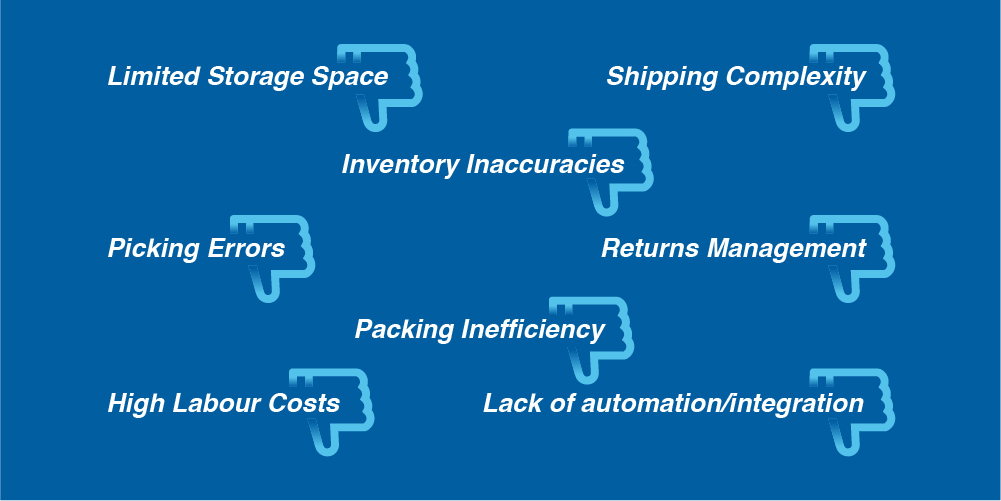
1. You know how many orders you have, but not how long they take to fulfil
Order volume is an obvious metric, but it doesn't tell you everything you need to know.
Two businesses could both process 1,000 orders a month while having completely different fulfilment requirements. One might be sending the same product in the same packaging every time. The other might pick several products, add an insert, check a personalised label, and assemble a bespoke package before anything can leave the building.
If you only look at the number of orders, you can miss the real pressure on the operation.
Look at the time involved at each stage, from receiving and locating stock to picking, packing, quality checking, and despatch. Once you know where the time goes, it becomes easier to see whether the problem is volume, process, or both.
Flow’s pick and pack service is designed around this process, with stock control and order fulfilment handled through its own systems. Its ecommerce service integrates with platforms including Shopify and WooCommerce, providing customers real-time information about orders and shipments. Business owners can start by requesting a consultation or trial to see how the service fits their fulfilment needs before committing long-term.
That visibility becomes increasingly useful as order numbers grow because you are no longer relying on someone to remember what happened to an order.
2. Your best fulfilment system is one person’s memory
In a growing business, someone usually seems to know everything.
They know where the stock is kept. They know which customer gets which insert. They know which boxes are used for which products and which orders need a little extra attention.
For a while, that can work remarkably well.
It becomes a problem when that person is on holiday, leaves the business or has too much else to do.
A fulfilment process should not depend on one person’s memory to keep it moving. Instructions need to be clear enough for someone else to follow, particularly when the business is bringing in temporary staff, adding new products or dealing with a sudden increase in orders.
This is one of the less obvious signs that an operation has outgrown its current setup. The question is not whether your most experienced employee can do the job. It is whether somebody new could follow the process accurately.
3. Your packing instructions live in someone’s head
This is closely related, but it is worth separating because bespoke packing can become complicated surprisingly quickly.
One customer might receive a thank-you card. Another receives a promotional leaflet. A third needs two products packed together. A seasonal order needs different packaging, while another needs a specific label applied before despatch.
None of that is wrong. In fact, tailored fulfilment can be an important part of the customer experience.
The difficulty comes when the process is being managed through memory, handwritten notes or a collection of emails.
Flow’s hand fulfilment operation handles jobs ranging from collation and labelling to product repackaging, bespoke enclosures, shrink wrapping, belly banding, loose inserts and promotional or seasonal gift packing. The team also carries out more involved hand assembly, including point-of-sale displays and other bespoke projects.
That experience matters because complicated fulfilment is not necessarily a reason to simplify the product. Sometimes the better answer is to build a reliable process around the complexity.
4. Every new product makes fulfilment harder
Adding another product should be good news.
If every new SKU creates another storage problem, another packing instruction and another manual workaround, however, it may be a sign that the underlying fulfilment operation needs attention.
The same applies when businesses introduce bundles or kits. A standard pick-and-pack system is excellent at picking individual products and putting them into an order. It is not always designed for assembling something that does not exist as a finished product until somebody puts it together.
This is where hand fulfilment and 3PL can overlap.
Flow has deliberately combined its hand fulfilment and pick-and-pack services so products can be assembled, customised, and prepared before moving into the normal fulfilment process. Examples include assembling product kits, adding promotional material, and creating customised orders, with services such as glueing, taping, and heat bending available where required.
For a business with a mixture of standard and bespoke orders, having those capabilities under one roof can remove a surprisingly awkward part of the supply chain.
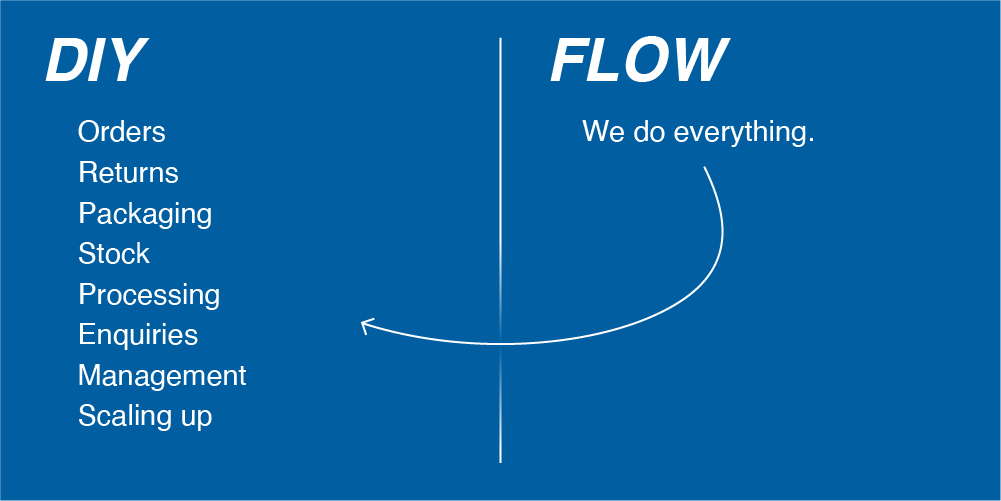
5. You are bringing in temporary staff every time demand increases
Seasonality is not necessarily a problem. Many businesses have predictable periods when order volumes increase.
The warning sign is when every busy period requires the same frantic response: clear a room, find temporary staff, buy more packing equipment, and hope everyone learns the process quickly enough.
Scaling fulfilment should not mean reinventing the operation every time demand changes.
A specialist fulfilment partner can provide additional space, people, and processes when needed, without the business having to retain that capacity year-round.
Flow describes flexibility and extensibility as part of its hand fulfilment service, including the ability to respond to seasonal variations, promotions and changes in demand.
That does not mean outsourcing is the right answer for every business. Many companies outsource only certain tasks, like storage, packing, or returns processing, while keeping other parts in-house. This flexibility lets owners maintain oversight where they prefer while accessing extra capacity and support when needed. Capacity should be part of the fulfilment strategy, not an emergency measure when the warehouse gets too busy.
6. You cannot easily answer, “Where is this order?”
A customer gets in touch and asks where their order is.
You check the ecommerce platform. Then someone checks the warehouse. Another looks at the courier system. Eventually you find the answer, but only after several people spend time figuring it out.
That is a warning sign.
Customers do not particularly care which system contains the answer. They expect the business to know what is happening with their order.
Flow’s pick and pack service includes a customer portal that provides visibility into orders, shipments, and fulfilment information, and its software can connect with Shopify and WooCommerce.
The benefit is not just having another piece of software. It is having information in one place so the business can see what is happening without chasing several people.
As order volumes increase, that visibility becomes much more important.
7. Returns are treated as someone else’s problem
It is easy to concentrate on getting orders out of the warehouse and forget about what happens when something comes back.
Returns still need to be received, checked, recorded and either put back into stock, repackaged, repaired, replaced or dealt with in another agreed way.
If returns sit in a corner waiting for someone to decide what to do, the problem won't disappear.
Flow’s hand fulfilment service includes returns management alongside other activities such as relabelling, rectification and repackaging.
This matters because reverse logistics is part of the customer experience too. A business can have an excellent outbound process and still create unnecessary frustration if it poorly organises the return journey.
8. A bespoke order creates a completely separate process
This is particularly common when a business has grown around a product that was originally fairly simple to fulfil.
Then somebody asks for something different.
A gift set needs assembling. A promotional item needs adding. A special customer needs a different enclosure. A display unit needs constructing. A product needs repackaging before it can be sent.
Suddenly, a second operation runs alongside the normal fulfilment process.
Flow has worked with exactly this kind of requirement. Its hand assembly service covers everything from packing individual products to assembling thousands of complex cardboard point-of-sale displays. In contrast, its wider contract packing service includes shrink wrapping, heat bending, glueing, taping, and FSDU construction.
One particularly useful example is Flow’s work with Twinkl, where the fulfilment requirements included pick-and-mix packs, variable inserts and more involved assembly. Flow’s case study explains how the work required bespoke handling that did not fit neatly into a standard automated fulfilment model.
That is a useful lesson for growing businesses: unusual fulfilment does not mean the product is too complicated. It may mean the process needs to be designed around what the product requires.
9. You are spending more time fixing fulfilment problems than improving the business
This is perhaps the easiest sign to recognise.
The founder helps pack orders instead of working on sales. The marketing team looks for missing stock. Customer service chases parcels. Someone from finance tries to figure out why postage costs changed. Everyone does a little fulfilment, but nobody is responsible for improving the whole operation.
At that point, fulfilment stops being a background business process and starts taking management attention away from everything else.
Flow’s own approach to outsourced fulfilment is built around taking those operational tasks away from clients so they can concentrate on growing their businesses. Its pick-and-pack service covers storage, stock control, picking, packing, and shipping, while its hand fulfilment operation handles more involved assembly and packing requirements.
The point is not just to make someone else’s warehouse busy. It is to give the business more time and control over what requires its attention.
10. You are measuring activity instead of performance
The final warning sign is perhaps the most important.
You know how many orders were shipped last month.
You know how many people packed them.
You know how much stock is in the warehouse.
But do you know where delays occurred, how many errors were made, how much rework was required, or what the fulfilment process actually costs the business?
A growing operation needs more than a tally of how many boxes have left the building.
It needs information that helps identify where the process can be improved.
That could mean tracking order turnaround times, stock accuracy, picking errors, returns, packaging costs, or time used on manual processes. The right measures depend on the business, but the principle is the same: if you cannot see where friction is, it is hard to remove it.
What happens when a fulfilment problem becomes urgent?
Sometimes there is no gradual warning.
A campaign deadline arrives. A product launch moves forward. A retailer places a larger order than expected. A supplier delivers late. Suddenly, a job that normally takes weeks must be completed in days.
Flow has experienced this first-hand.
When Marie Curie needed to send its annual Daffodil Appeal, the planned flat badge had been replaced with a three-dimensional artificial daffodil. Mechanical enclosing was no longer possible, and Flow was brought in with just ten days to recover the campaign. The project involved 500,000 fundraising letters, and after stock arrived, they had fewer than eight days and more than 2,500 staff hours to complete the work. Flow trained two teams of 15 people, introduced ongoing quality checks, and met the campaign deadline.
That is an extreme example, but it demonstrates something important about fulfilment.
The process has to cope with what actually happens, not just what was supposed to happen.
The cost of a fulfilment problem is not always obvious
When businesses consider outsourcing, they often compare the cost of their current operation with the price quoted by a fulfilment company.
That is a useful starting point, but it is not the whole calculation.
Employees spend time packing orders. There is warehouse space. Packaging materials and equipment are needed. Mistakes and replacements occur. Temporary staff cost money during busy periods. Management spends time dealing with problems. There is also the opportunity cost of having people work on fulfilment instead of sales, customer service, or product development.
Flow has documented this in its work with a national online estate agent. The business used direct mail as a core part of its marketing plan and approached Flow to improve its fulfilment operation. Flow’s case study reports annual savings of £22,800, with mailings released within 24 hours and improvements including automated stock control and a centralised “Do Not Send” process.
One practical way to compare the true costs of in-house and outsourced fulfilment is to list all relevant expenses. This helps you see where costs sit and make an informed decision. Here is a simple checklist:
- The time your staff spend picking, packing and processing orders
- The cost of bringing in temporary staff when order volumes increase
- The warehouse space you need and what it costs to store stock
- Packaging, equipment and other materials needed to get orders out
- The software and technology you rely on to manage fulfilment
- Mistakes, including the time and cost involved in correcting or replacing orders
- The work involved in dealing with returns and getting stock back into the system
- The management time spent dealing with fulfilment problems, chasing orders and fixing issues
To calculate and compare, total these costs for your current in-house operation, then request a detailed quote from your chosen fulfilment provider covering the same items. This side-by-side view gives a clearer picture of the real monetary impact and helps you choose the option that best fits your business.
The lesson is not that every business will save £22,800 by outsourcing.
It is that the cost of fulfilment is often spread across much more of the business than the obvious packing and postage bill.
So, has your fulfilment actually outgrown your business?
Not necessarily.
A business can have a busy warehouse and still have a workable operation. Likewise, a company processing a small number of orders can have a fulfilment process consuming too much time.
The useful question is whether the existing setup still makes sense for the business you are running today.
If stock is hard to control, bespoke work creates separate processes, orders are hard to track, returns build up, or your team spends too much time packing instead of their actual jobs, it may be time to look at the process more closely.
And outsourcing does not have to mean handing everything over.
Some businesses need straightforward pick and pack. Others need storage and stock control but want to keep part of the process themselves. Some need hand assembly, contract packing, or specialist preparation before products enter a normal fulfilment workflow. Others need a combination of these services.
Flow’s model is built around that flexibility, with pick and pack, 3PL, hand fulfilment, contract packing, direct mail fulfilment and bespoke assembly available alongside one another.
The starting point should therefore be the problem, not the service.
Where is your fulfilment actually slowing the business down?
Once you know that, you can start working out what needs to change.
A simple fulfilment health check
Before deciding whether to outsource, take an honest look at your current operation. A practical first step is to schedule a fulfilment audit or book a consultation with a provider. This helps identify challenges and opportunities, using external expertise to point out areas for improvement you might have missed.
Can someone other than your most experienced employee follow the fulfilment process without asking for help? Can you locate any product quickly? Can you tell a customer where their order is without checking several systems? Can you cope with a sudden increase in demand without reorganising the entire operation? Can you introduce a new product without creating a completely new packing process? Can you process returns without them becoming a backlog?
And do you know what your fulfilment operation actually costs once you include staff time, space, equipment, packaging, errors and management time?
If the answer to several of those questions is no, the problem may not be that you need to work harder.
Your fulfilment process may have reached the point where it needs to change.
Reviewed and updated: September 2026
Examples and service information in this article are based on Flow Fulfilment’s published services and case studies. Individual fulfilment requirements, costs and outcomes vary according to the products, order volumes, processes and service levels involved.

